
Frequently Asked Questions: Batteries
When it comes to electric powered vehicles the battery is without doubt the most misunderstood and abused component in the electrical system! It is not uncommon to just think of a battery as something that is there and it makes the vehicle go. Why give a second thought about any battery preventive maintenance; after all it's just a battery. What makes it so important to understand and maintain a set of batteries? For starters, the cost of a set of batteries isn't exactly cheap and recently have increased anywhere from 7 to 10% (not including install labor). So, just what exactly is a battery and how do we maintain it? Let's examine the questions and set the battery mystery to rest.
What is a battery?
- By definition, a battery is a storage reservoir with the ability to deliver energy in the form of electricity. This storage is a repeated endeavor and is stored in the form of chemical energy.
- The battery is made up of several different parts.
- Case
- Lead
- Separators
- Positive Plates
- Negative Plates
- Cells
- Sulfuric Acid
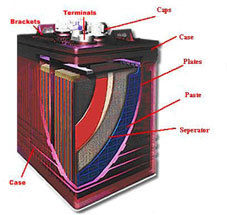
Granted, this is a very brief parts list and for the sake of space we will not go into a lot of technical 'inside' stuff. All this is saying is there is more to a battery than the heavy box that meets the eye. A battery is made up of multiple cells and it takes a minimum of two cells to create a battery. Inside each cell are the different parts mentioned. Each cell has a nominal voltage reading of 2.12 volts. If you have three cells connected in series you will have a six volt battery. The number of cells per battery times the nominal cell voltage of 2.12 volts is the voltage rating of a given battery. Note: Some battery manufacturers use a 2.11 reading per cell and this can vary within the industry. We will be using the 2.12 reading throughout the article.
- The battery produces electrical energy in the form of Voltage and Amperage. Voltage is units of pressure of an electric current. Amperage is the units of quantity of an electric current. At the same time something must cause the voltage to move the current and that is resistance. The resistance in the electric vehicle is created by the drive motor, or other components within the system. Let's say the drive motor demands 100 amps to move the vehicle and the battery is asked to deliver the same amount. Two things must happen and one is the right voltage must be available to push the amount of amperage to the motor. The second thing is the motor must be of the same voltage and able to handle the voltage applied. At this point the motor has become a resistor and makes the demand of the battery (current forced though a resistance of one ohm by a pressure of one volt is one ampere). What is important to understand at this point is the battery not only has to be able to deliver voltage/amperage; it must also be able to deliver this for a sustained period of time. This is called battery capacity or ampere hours. You can also term this as Kilowatt hour capacity. A lead acid battery ampere hour rating is amps X time (in hours). One of the measurement standards is a 20 hour rate at a given discharge amperage. Another method is capacity in minutes. Either way we can determine the ability of what the battery can produce in the system. Why this is important is if a battery is mismatched to a system greater than it can produce, run time will be dramatically cut short and component damage can possibly occur. An example of this would be replacing six 6 volt batteries with three 12 volt batteries. So when choosing batteries make sure they are the right voltage and capacity.
Now that we have some basics as to what a battery is, let's talk aboutmaintenance, trouble shooting, and battery safety.
BEFORE BEGINNING ANY BATTERY TESTING OR REPAIR MAKE SURE YOU ARE WEARING PROPER EYE PROTECTION!
Keep all spark and flames away from the batteries at all times. Know where the closest eye wash is at all times. Do not wear rings, watches or jewelry. I think it might be wise at this point to explain what the enemies of the battery pack are. First and foremost the number one enemy of a battery is a human being! That is because of the lack of understanding of the how and why of battery maintenance. The second biggest enemy a battery has is heat! Heat can be caused by over charging, over discharging, incorrect batteries for the application and the ambient surroundings. Old worn out batteries will cause heat due to mossing, sulfation, or shorted cells due to the positive plate shedding process.
- Mossing is a by-product of incorrect forming of lead-calcium, leadselenium or lead-antimony (etc.). Along with batteries setting unused you can actually see a formation of moss in the cells.
- Stratification is from the batteries setting for long periods and due to the fact that acid is heavier than water the acid will settle to the bottom of the battery. This allows quick evaporation of the water and heavy concentrations of acid at the bottom of the battery cell.
- Sulfation is caused from under charging and batteries setting in an uncharged state. Note: The cells of a sulfated battery will give low specific gravity and open circuit voltage readings. On charge, the voltage readings will be unusually high.
Remember each time you charge your batteries you remove one life from the battery (cycles) and batteries can only be cycled so many times. Each charge cycle will produce a natural phenomenon called shedding on the positive plates and over time this will accumulate inside at the bottom of the battery and cause the positive plate to push upward (positive plate growth). This can be used as a guide to the health or usefulness of a battery. One comment I do want to interject at this time is proper disposal of the batteries. The EPA will more than heavily frown on you if proper disposal procedures are not followed. Technically you are a hazardous waste generator and by law you must see to it the batteries or any battery materials are given to a LICENSED Recycler.
Battery Maintenance: The Cart Doctors 10 Commandments of Battery Health
- Keep the tops of the batteries clean and dry. The batteries can be cleaned with a solution of baking soda and water. Make sure the cell caps are in place and you have the proper eye protection (face shield) and skin protection (rubber gloves). Do this in an area you don't mind staining the surface the batteries are over.
-
Fill the battery cells only after you charge and never over fill. Usually a 1/4
inch above the plates is a good level. Again, this varies between
manufacturers. Yes, at 1/4 inch you will need to check more often but you will
have less build up of acid droplet's on top of the batteries. If you prefer a 1/2
inch you can expect more acid accumulation on the battery tops.
Remember to use distilled water unless you know the mineral content of your
local water supply.

- Allow enough charge time based on 80% discharge. Usually this is 8 to 10 hours.
- Always use an automatic charge controller. Automatic charge controls allow for proper mixing of the solution in the batteries and prevent over charging.
- Never allow the batteries to set unused for extended periods of time. This can cause sulfation, mossing, or stratification. Perform a freshening charge every 45 to 60 days and more frequently in hotter climates.
- Do not overcharge or use an overrated charger.
- Do not discharge the batteries beyond 80%. A battery discharge indicator will help in preventing over discharge.
- Keep all battery cables clean and tight. Make sure the cables are not corroded or have weak and worn out eye connectors. Spray the cables with anti corrosive spray after they are clean and tight.
- Make sure the battery hold downs are tight, but not over tight as to crush or crack the case. Spray coat the hold downs with anti-corrosion spray.
- Keep accurate records for future reference. Record the voltage and specific gravity of each battery cell. During the next battery service you can tell by the records if any changes have occurred. Records also will track warranty issues or just plain prompt you to perform a scheduled maintenance. Note: Battery Sets are numbered from the first battery positive connection to the Buggy and this is battery number one. From battery number one they are numbered (in series) 2, 3, 4, 5, and ending at battery (number six) negative terminal. Battery cell numbers are from the positive terminal as being number one cell, 2, 3, and 4 for an eight volt battery (example). So as a record keeping example it will be listed as (Battery #3) cell number 2 has a reading of 1.250 specific gravity in February and in May it has changed to 1.230. This should send up a red flag and at this point you need to examine this battery more closely and replace or repair as needed.
Trouble Shooting:
Since the heart and soul of an electric vehicle are the batteries, the first place to start with electric vehicle trouble shooting is always the batteries. Some things we need to know about trouble shooting batteries are as follows.
- All lead acid cells are rated at 2.12 volts per cell with the exception of spiked or non lead acid batteries. Knowing that we have a base voltage to work from our next step is to determine how many cells you have. Simply count the number of water fill ports and multiply that times 2.12, and that is the battery pack voltage. So if we have 18 cells in the battery pack, the voltage is 38.16 volts and is termed a 36 volt system. Knowing the exact voltage is important to test procedure. Say if we are at 36 volts, what will that mean to us? At 36 volts the cell voltage is 2 volts and at 2 volts this means the pack is discharged and will need charging before any further testing can be performed. This brings up the next test which is specific gravity. Specific gravity is just a measurement of the ratio of sulfuric acid to water. At 2 volts the specific gravity will be around 1.160 specific gravity. A battery is deemed fully charged at 1.280 specific gravity and discharged at 1.160. The 84 rule also supports the 1.160 reading as 2 volts minus .84 equals 1.160 gravity. Again some manufacturers use different gravity readings and we will use 1.280. So to say you have 36 volts, the batteries need charged as the correct full charge reading is 38.16 and in trouble shooting you need to understand that.
- When testing a battery for voltage that is at rest (not being used), we call this an open circuit voltage (OCV) test. In a battery pack, testing of individual cell voltage is not feasible. We need to remember at this point that multiple cells make up a battery and most deep cycle lead acid batteries are either 6 volt or 8 volts. This is true for Buggy's and in most cases any electric vehicle. In a battery pack you normally will have six 6 volt batteries (18 cells) or six 8 volt batteries (24 cells). There are also some that use eight 6 volt batteries (24 cells), as well as other combinations. An OCV test can tell us a lot in terms of battery condition. A good example of this is when you perform an OCV on each individual battery, a problem can be found rather quickly. Let's say you have OCV readings of 6.36, 6.36, 4.8, 6.3, 6.1, and 6.21 on the individual batteries. What this tells us is battery number 3 is different and it is low and will need to be further tested. Also, battery number 5 is a tad low. What we are seeing are scattered voltages and that tells us there is a definite issue with the battery pack. First we will need to replace number 3 battery and recharge the pack and see if the scattered voltages improve. If improvement is not seen in number 5 battery, further testing will be required. To do this we will need to perform a discharge test.
- A discharge test for a 36 volt pack consists of a constant load of 75 amps applied for a period of 107 minutes. This is the normal discharge rating of a new T105 Trojan Battery. During the discharge process, the battery voltage can be monitored. This is called load volts and once again you are looking for a measurement that is different than the others. Say you read 5.88, 5.80, 3.2, 5.66, 5.70, and 5.67. Notice the number three battery reading is different. A reading of 3.2 is a defective battery that will not perform up to potential. Any system voltage reading below 31.5 volts at 75 amps before 60 minutes has passed is considered a system failure. It is my opinion after 35 years in the battery business that any single weak battery in a battery system will soon fail and a replacement should repair the problem, and thus prevent further damage to the rest of the pack. A general rule of thumb is if the entire pack is more than 2 years old, replace the entire set. Mixing a new battery with a set of old worn out batteries will destroy the new battery in a short period of time.
- There are other simple load tests that the automotive industry uses that can tell a quick story. However, it cannot sustain a load long enough for a total analysis. A cadmium test can be used, but I do not recommend this as it is a heavy metal and can be hazardous. One other test can be used to determine the health of a battery pack and this is the charging finish rate. The finish rate is voltage at the end of the charge cycle and is usually around 4 or 5 amps output from the battery charger. Again, we are using a 36 volt system for this test. What you will see is higher on charge voltages than you did on the OCV tests. New batteries tend to have a higher finish rate than older batteries. A good finish rate is usually around the 7.35 volts for each 6 volt battery. However, newer batteries can go as high as 8.25 volts. Let's say you read 7.35, 7.40, 7.33, 7.34, 6.99, and 7.10. What this tells us is number 5 and 6 are different and will need further testing or replacement. With two batteries showing a low reading and taking into consideration the age of the pack, I would recommend you replace the set. Two batteries such as this in a newer pack would indicate issues with over discharging or excessive loads on the two batteries such as head lights and accessories. Again, never discharge batteries beyond the 80% level.
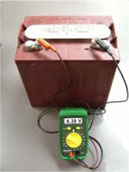 Voltmeter Connections
In closing remember Batteries are a storage tank of electrical energy, and do not like to set dormant; 'they need to be used'. Batteries like to be kept clean and have clean and tight connections.
By obeying the Cart Doctor's Ten Commandments for good health of your batteries, you'll get the best performance out of the most misunderstood component in your Electric Buggy.